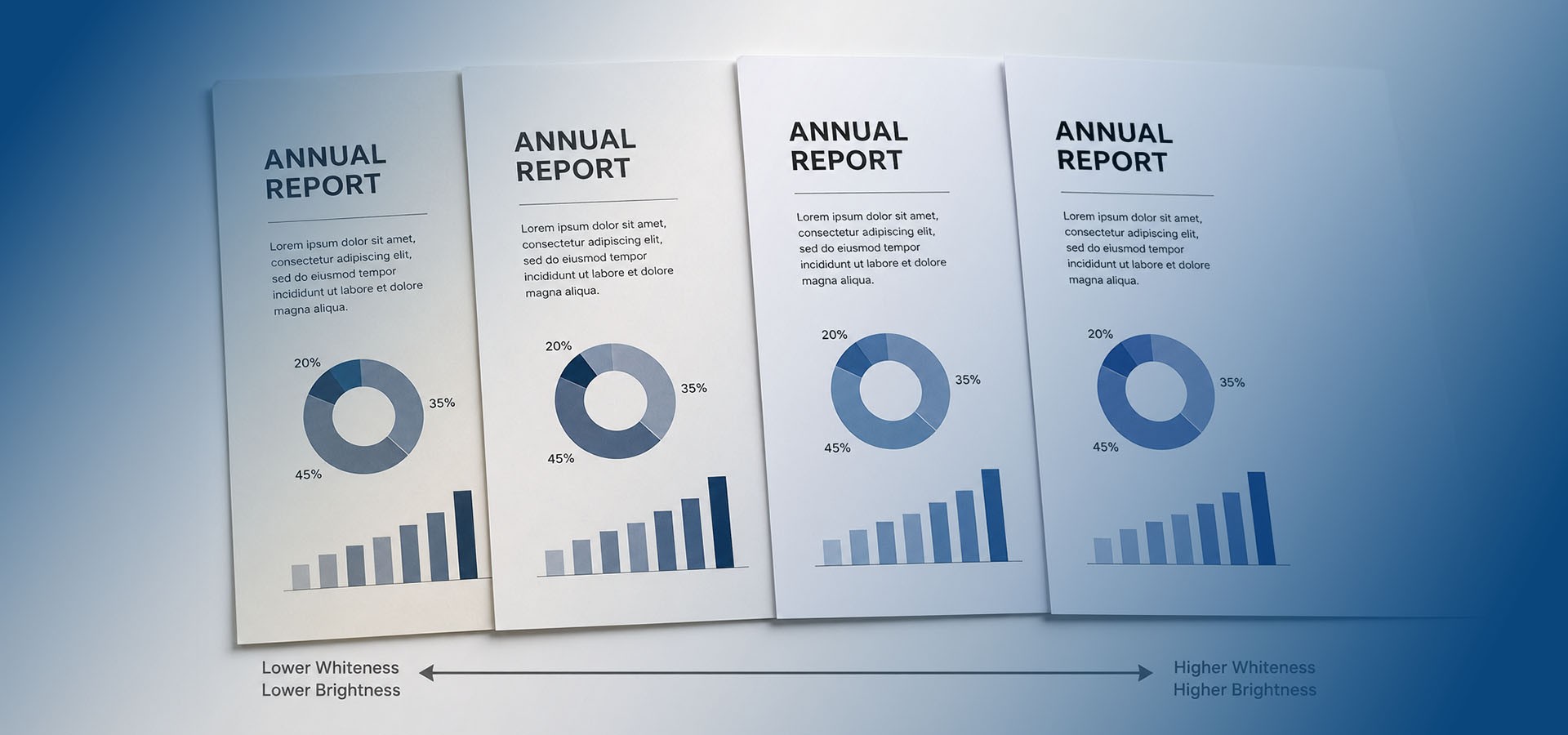
Document legibility and executive aesthetic quality depend heavily on the optical characteristics of the printing substrate. When evaluating copy paper, grammage alone does not dictate visual impact; CIE Whiteness and ISO Brightness ratings directly govern print contrast, graphical clarity, and overall reading comfort. Choosing the appropriate optical specification ensures razor-sharp text rendition, accurate color gamut reproduction, and a polished corporate presentation.
Optical Performance: Technical Distinctions in Paper Appearance
High CIE Whiteness & Premium Brightness (>160 CIE)
- Pinpoint Contrast: High-density black typography stands out cleanly, providing effortless reading across dense text blocks.
- True-to-Life Color Saturation: Prevents tonal drift in colored bar charts, pie graphs, and corporate brand graphics.
- Uniform Light Scattering: Superior surface calender finishing optimizes toner particle adherence and prevents micro-feathering.
Standard & Utility Grades (<145 CIE)
- Subtle Gray or Dull Cast: Lower optical reflectance diminishes graphical punch and visual crispness.
- Toner Bleed Vulnerability: Less refined fiber sizing may lead to softer character boundaries on detailed diagrams.
- Targeted Application: Well-suited for single-sided internal drafts, temporary forms, and rough archiving copies.
Diagnostic Review: Evaluating Chart Fidelity & Toner Stability

Optical Specifications & Functional Application Matrix
| Technical Characteristic | Executive Premium Paper | Standard Corporate Supply | Utility / Economy Grade |
|---|---|---|---|
| CIE Whiteness Scale | 160 – 170+ CIE | 145 – 155 CIE | 130 – 140 CIE |
| ISO Brightness Value | 104% – 112% ISO | 95% – 100% ISO | 88% – 92% ISO |
| Text Contrast & Edge Definition | Ultra-sharp with maximum clarity | Clear, balanced everyday legibility | Moderate; prone to a washed-out tone |
| Recommended Business Use | Annual corporate reports & contracts | Administrative correspondence & bills | High-speed draft printing |
Procurement Strategies: Matching Optical Quality to Purpose
1. Pairing High Whiteness with Controlled Opacity
A high CIE rating should always be supported by balanced sheet opacity. When printing duplex reports, ensure an opacity rating of at least 92%–95% on 80 GSM stock to eliminate reverse-side show-through and protect legibility.
2. Reading Comfort on Text-Heavy Documentation
For extensive contracts and technical manuals, excessive fluorescent blue reflectance can cause eye strain during extended reading sessions. A balanced 160–165 CIE sheet delivers crisp visual contrast while preserving ergonomic visual comfort.
Purchaser Evaluation Checklist
- Verify Certified CIE Numbers: Check packaging labels for standardized CIE values to ensure consistent shade matching across orders.
- Prioritize ECF/TCF Bleached Pulp: Ensures environmental compliance and protects paper against premature yellowing during long-term storage.
- Inspect Samples Under Daylight: Artificial office lighting can mask subtle yellow or gray casts; always assess paper whiteness under natural daylight.
Need High-Whiteness A4 Paper for Your Corporate Documentation?
Contact our supply specialists to review product samples, compare technical optical ratings, and secure competitive volume supply agreements.