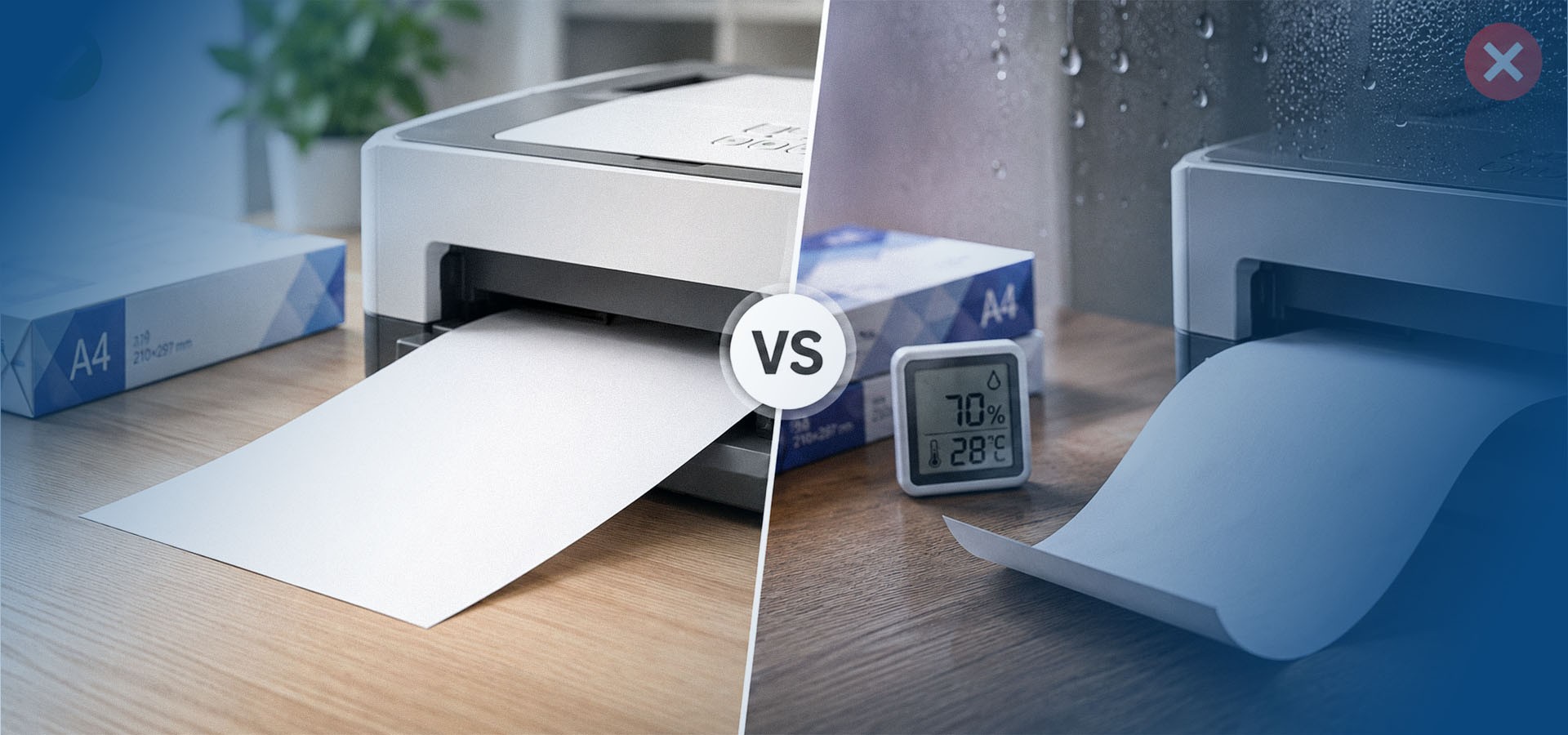
Experiencing wavy or heavily curled sheets from your laser printer is a direct indication of adverse office climate conditions and cellulose moisture absorption. When moisture-laden copy paper passes through heated fuser rollers, rapid vapor escape creates structural fiber stress, leading to edge deformation and persistent mechanical jams. Implementing proper climate controls and storage routines ensures consistently crisp, flat document outputs.
The Physics of Paper Deformation Under Ambient Moisture
Performance in a Controlled Climate (40% - 50% RH)
- Flat Output Integrity: Printed pages emerge smooth and rigid, preserving professional document aesthetics.
- Frictionless Feeding Mechanics: Eliminates electrostatic sticking and prevents accidental multi-sheet pulls.
- Sharp Toner Adhesion: Uniform heat transfer ensures high-contrast character edges and smudge-free graphics.
Impact of Excessive Ambient Humidity (Above 65% RH)
- Edge Waving & Curling: Unequal expansion across the sheet surface leads to post-fusing curvature.
- Elevated Jam Frequencies: Curled leading edges trigger misfeeds and block delivery sensor paths.
- Compromised Print Quality: Water vapor reduces toner bonding efficiency, causing faded patches and toner flaking.
Visual Impact: Wavy Sheet Distortion Under High Humidity
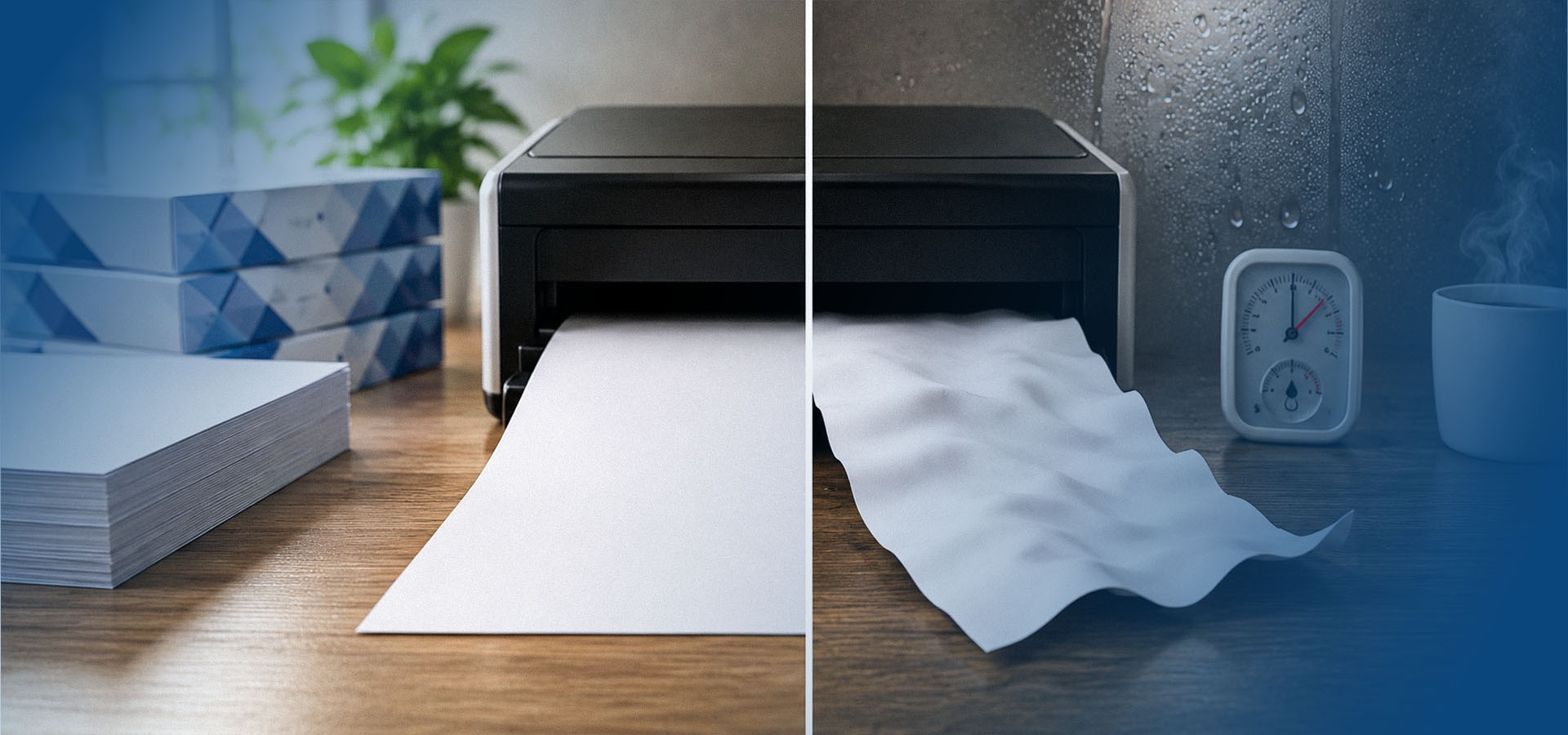
Performance Matrix: Sealed vs. Moisture-Exposed Paper
| Performance Parameter | Properly Conditioned Paper | Moisture-Compromised Paper |
|---|---|---|
| Post-Print Flatness | Completely flat and rigid | Wavy edges with noticeable upward/downward curl |
| Feed Jam Risk | Minimal under normal workloads | High; recurrent stoppages at exit and fuser rollers |
| Tray Separation | Smooth, single-sheet pickup | Sheets stick together due to humidity and static |
| Text Sharpness | Crisp, dark, and resilient | Prone to background shading and smudging |
Preventive Storage Protocols for Office Environments
1. Maintain Factory Wrapper Integrity
Original A4 ream wrappers include specialized moisture-barrier linings designed to protect paper fibers from atmospheric humidity. Keep reams fully sealed until loading them into the printer, and securely tape opened packs when storing remainder stock.
2. Paper Acclimatization Before Printing
When transferring paper cartons from cold storage or unconditioned warehouses, allow boxes to sit unopened in the print room for at least 24 hours to reach thermal equilibrium, preventing condensation buildup on sheet edges.
Quick Action Checklist for Print Operators
- Elevate Stored Inventory: Keep paper boxes on pallets or shelves at least 10 cm above concrete floors.
- Match Load to Daily Output: Do not leave large stacks sitting exposed in open feed trays over weekends.
- Troubleshoot Curling Fast: If output curls, turn the paper stack upside down in the tray or reload with a freshly unsealed pack.
Looking for High-Performance, Barrier-Wrapped A4 Copy Paper?
Contact our supply specialists today to explore moisture-protected, high-runnability paper grades engineered for seamless office productivity.